Best Portable Solar Panels in 2026
EcoFlow, Jackery, Anker SOLIX, Bluetti and Renogy folding solar panels compared, with rated vs real-world output and connectors explained.
- 5 picks
- 5 min read
- Updated Nov 20, 2026
As an Amazon Associate I earn from qualifying purchases. If you buy through a link here we may earn a commission, at no extra cost to you. Details
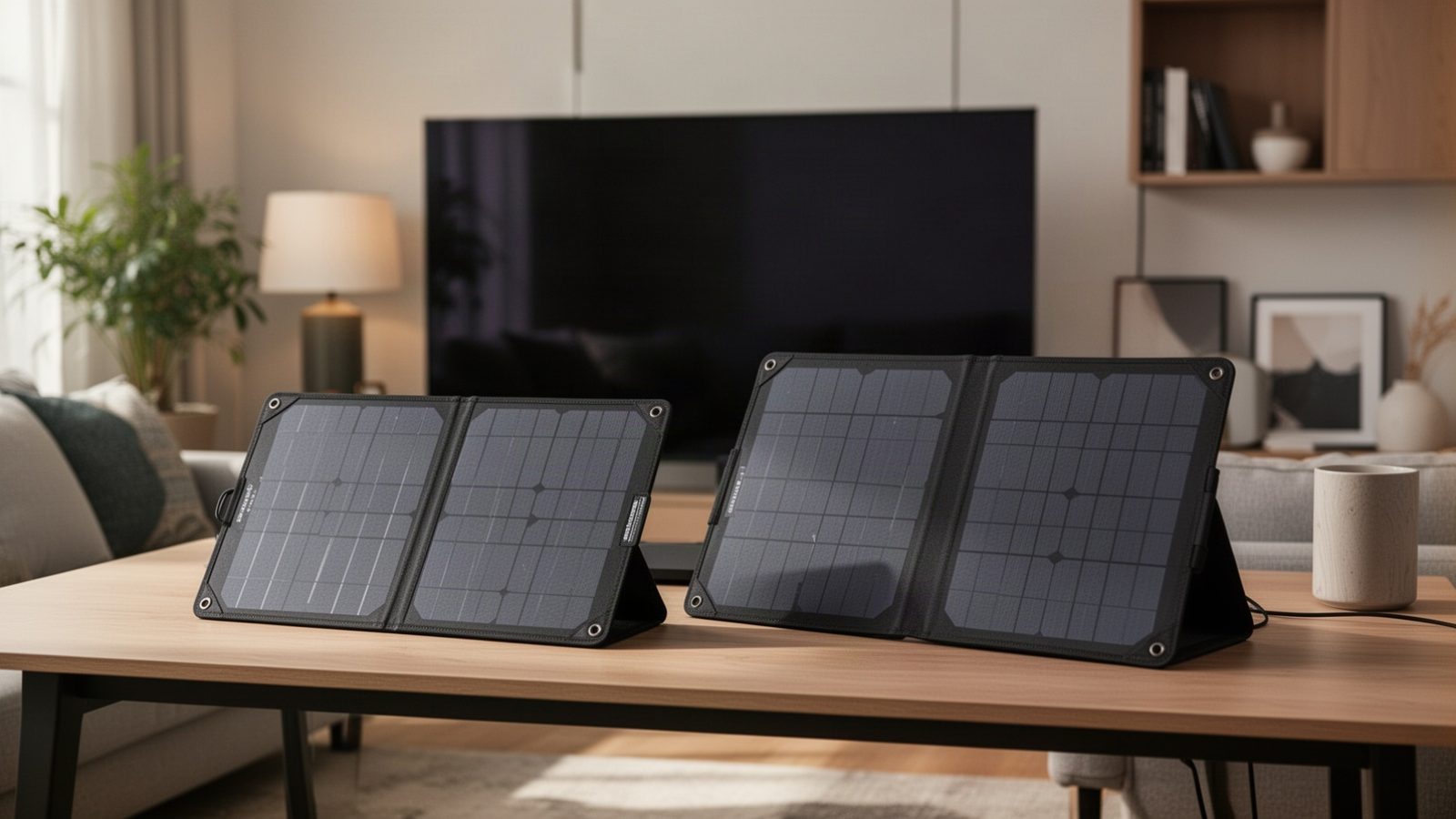
A portable solar panel turns a power station into an off-grid power source. Unfold it at a campsite, on an RV roof rack or in the backyard during an outage, point it at the sun, and it trickles energy back into your battery. Most fold like a briefcase or a book, have built-in kickstands and pack into a carry case.
The number printed on the panel is only part of the story. A 200W panel rarely delivers 200W in real life, and it only helps if its voltage and connector match your power station's solar input. We compared popular folding panels from EcoFlow, Jackery, Anker SOLIX, Bluetti and Renogy on rated output, build, portability, connectors and compatibility, and explain what to expect from each in real conditions. If you haven't chosen a power station yet, start there, since the station's solar input limits decide which panels make sense.
The lineup
 Best overall EcoFlow 220W Bifacial Portable Solar Panel
Recharging mid-size power stations quickly
9.0 Buy Now on Amazon
 Best for Jackery owners Jackery SolarSaga 100W
Plug-and-play charging for Jackery Explorer stations
8.7 Buy Now on Amazon
 Best for Anker SOLIX owners Anker SOLIX PS200 Portable Solar Panel
Anker SOLIX stations and mid-size setups
8.5 Buy Now on Amazon
 Best for Bluetti owners Bluetti PV200 Solar Panel
Bluetti stations and MC4-based setups
8.4 Buy Now on Amazon
 Best for 12V batteries Renogy 100W Portable Solar Suitcase
RVs, boats and campers with 12V batteries
8.2 Buy Now on Amazon
AI picture
- Rated output220W (front side)
- Panel styleFolding, bifacial
- Best matchEcoFlow stations; others with adapters
- ConnectorMC4
#1Best overall9.0/10
EcoFlow 220W Bifacial Portable Solar Panel
EcoFlow
A folding bifacial panel that collects light on both sides and uses standard MC4 connectors.
Good for: Recharging mid-size power stations quickly
- Bifacial design adds output over bright surfaces
- Standard MC4 connectors work with many stations via adapters
- Integrated stand and carry case
- Good match for 1kWh-class stations
- Bulky and heavier than 100W panels
- Rear-side gain depends on the ground surface
EcoFlow's 220W bifacial panel is a strong all-rounder for anyone with a mid-size power station. Its front side is rated at 220W, and the rear side picks up reflected light, which adds a little extra output when the panel sits over sand, snow, concrete or a light tarp.
It uses standard MC4 connectors, so with the right adapter cable it can charge stations from other brands, though it pairs most easily with EcoFlow's own. A built-in stand and carry case make setup quick.
At this size it is heavier and bulkier than a 100W panel, so it suits car camping, RVs and backyard backup more than backpacking.
The short version: The best all-round folding panel for 1kWh-class power stations.
AI picture- Rated output100W
- Panel styleFolding with kickstands
- Best matchJackery Explorer stations
#2Best for Jackery owners8.7/10
Jackery SolarSaga 100W
Jackery
A popular, easy-to-carry folding panel designed to plug straight into Jackery power stations.
Good for: Plug-and-play charging for Jackery Explorer stations
- Plug-and-play with Jackery stations
- Light enough to carry and set up alone
- Built-in kickstands and handle
- Can be combined with a second panel on larger stations
- 100W charges large stations slowly
- Needs adapters for other brands
The SolarSaga 100W is one of the most widely used portable panels, mainly because it pairs so easily with Jackery's Explorer stations. Unfold it, stand it on its kickstands, plug it in, and the station starts charging.
At 100W it is light and compact enough to carry and set up alone, which suits weekend camping and smaller stations. On a 1kWh-class station, one panel is slow; Jackery stations can accept multiple panels, so many owners add a second.
Jackery has used different connectors across station generations, so confirm that the panel version and cable match your station, and plan for an adapter if you use another brand.
The short version: The easiest solar add-on for anyone who already owns a Jackery.
AI picture- Rated output200W
- Panel styleFolding
- Best matchAnker SOLIX stations
#3Best for Anker SOLIX owners8.5/10
Anker SOLIX PS200 Portable Solar Panel
Anker SOLIX
A 200W folding panel from Anker SOLIX designed to pair with its power stations.
Good for: Anker SOLIX stations and mid-size setups
- 200W suits 1kWh-class stations
- Good output for its folded size
- Pairs simply with Anker SOLIX stations
- Folds into a carry-friendly package
- Heavier than 100W panels
- Check cable compatibility for other brands
For Anker SOLIX power station owners, the PS200 is the natural solar companion. Its 200W rating is a good fit for 1kWh-class stations such as the SOLIX C1000, and Anker designs it to connect simply to its own stations.
As with any panel, re-angling it toward the sun every couple of hours has a real effect on how much energy you collect, so set it up somewhere you can reach easily. Folded, it packs into a size that fits a car trunk or an RV storage bay.
As with any 200W panel, it is heavier and bulkier than 100W options. If you use another brand's station, check the connector and voltage compatibility before buying.
The short version: A well-matched 200W panel for Anker SOLIX power stations.
AI picture- Rated output200W
- Panel styleFolding
- Best matchBluetti stations; others with adapters
- ConnectorMC4
#4Best for Bluetti owners8.4/10
Bluetti PV200 Solar Panel
Bluetti
A 200W folding panel with MC4 connectors that pairs with Bluetti power stations.
Good for: Bluetti stations and MC4-based setups
- Standard MC4 connectors
- 200W suits mid-size stations like the AC180
- Folds into a portable package
- From a well-established power station brand
- Bulky for hiking
- Other brands' stations need adapter cables
The PV200 is Bluetti's mid-size folding panel and an easy match for stations such as the AC180. It is rated at 200W and uses standard MC4 connectors, which means it can also charge other brands' stations if you have the right adapter and stay within their input limits.
It folds into a package that fits in a car trunk or RV storage bay, and the MC4 cables make it easy to add a second panel later if your station's input limits allow.
Like other 200W panels, it is too bulky for backpacking. For car camping and backup charging, it is a dependable partner for Bluetti owners.
The short version: A solid 200W panel for Bluetti stations and MC4-based setups.
AI picture- Rated output100W
- Panel styleFolding suitcase
- Best match12V batteries (RV, marine, camper)
#5Best for 12V batteries8.2/10
Renogy 100W Portable Solar Suitcase
Renogy
A folding suitcase panel with a built-in charge controller for topping up 12V batteries directly.
Good for: RVs, boats and campers with 12V batteries
- Built-in charge controller for direct 12V battery charging
- Rugged suitcase design with stand
- From a long-established solar brand
- No power station required
- Heavier and bulkier than fabric panels
- Less convenient for power stations than brand-matched panels
Not every off-grid setup involves a power station. Renogy's 100W solar suitcase is designed to charge the 12V batteries found in RVs, campers and boats directly, using a built-in charge controller that regulates charging so the panel doesn't overcharge the battery.
The rigid folding suitcase is sturdier than fabric panels, with a stand to angle it toward the sun, and Renogy has a long track record in RV and off-grid solar.
It is heavier and bulkier than a fabric panel, and it isn't the simplest choice for power stations, which already have their own charge controllers. Check that the controller settings match your battery type before connecting, and follow the manufacturer's instructions.
The short version: The right portable panel for keeping an RV or boat battery topped up.
Compare at a glance
| Pick | Rated output | Panel style | Best match | Connector | Score |
|---|---|---|---|---|---|
| #1 EcoFlow 220W Bifacial Portable Solar Panel | 220W (front side) | Folding, bifacial | EcoFlow stations; others with adapters | MC4 | 9.0 |
| #2 Jackery SolarSaga 100W | 100W | Folding with kickstands | Jackery Explorer stations | — | 8.7 |
| #3 Anker SOLIX PS200 Portable Solar Panel | 200W | Folding | Anker SOLIX stations | — | 8.5 |
| #4 Bluetti PV200 Solar Panel | 200W | Folding | Bluetti stations; others with adapters | MC4 | 8.4 |
| #5 Renogy 100W Portable Solar Suitcase | 100W | Folding suitcase | 12V batteries (RV, marine, camper) | — | 8.2 |
Specs come from manufacturer listings when we wrote this guide and can change between production runs.
Buying tips
Rated watts versus real-world output
Panel ratings are measured in lab conditions with strong, direct light and cool cells. Outdoors, expect noticeably less. Many owners see roughly 60–80% of the rating in good midday sun, and much less in the morning, evening, through haze or with any shade. Heat also lowers output, so a panel on a scorching day can underperform one on a cool, clear day.
Bifacial panels collect some extra light from their back side when set up over a bright surface such as sand, snow or a light-colored tarp.
Folding panel or rigid panel?
Folding fabric panels are light, pack flat and set up in a minute, which makes them ideal for camping and occasional outage use. Rigid or suitcase panels are heavier but sturdier, and they suit RVs and permanent backyard setups. For more than about 200W, two mid-size folding panels are often easier to carry and aim than one huge panel.
Match the panel to your power station
- Wattage: don't buy more panel than your station's maximum solar input can use, unless you plan to upgrade.
- Voltage: each station has a solar input voltage range. Connecting panels in series raises voltage; exceeding the limit can damage the station, so follow the manufacturer's instructions.
- Connectors: MC4 is the industry standard for solar cables. Many stations instead use Anderson, XT60, DC7909 or DC8020 inputs, so you may need an adapter cable. Brand-matched panels usually include the right cable.
How long does charging take?
Divide the station's capacity (Wh) by the panel's realistic output. A 1,000Wh station fed by a 200W panel producing around 140W needs roughly seven hours of good sun, which in practice can mean more than one day. Larger stations often benefit from two panels.
Setup tips
- Face the sun directly and adjust the angle every couple of hours; a kickstand makes this easy.
- Avoid shade. Even a branch's shadow across part of a panel can cut output sharply.
- Keep the station in the shade while the panel sits in the sun; batteries charge best when they are not hot.
- Charging through a window works poorly, since glass and angles reduce output.
Care and durability
Wipe panels with a soft, damp cloth, keep the connectors dry and capped, and store them folded and dry. Water-resistance ratings vary and often don't cover the junction box or cables, so bring panels in during heavy rain unless the maker says otherwise. Don't stand on or sharply bend panels, and keep them secured in wind.
FAQ
QDo portable solar panels work on cloudy days?
They still produce some power, but output can drop to a small fraction of the rating under heavy cloud. Plan for slower charging, and use a wall or car charger when you can to top up.
QCan I use any brand of solar panel with my power station?
Often, if the panel’s voltage falls within the station’s solar input range and you have the right adapter cable. Brand-matched panels are simpler because they include the correct connector. Check both manuals before mixing brands.
QCan I connect two panels together?
Yes, in series or parallel depending on your station. Series adds voltage, and parallel adds current. Stay within the station’s input limits and use the manufacturer’s recommended cables and connectors.
QCan I charge my phone directly from a portable solar panel?
Some panels have USB ports for direct charging, but output fluctuates with clouds and shade. Charging a power station or power bank and then charging your phone from it is more reliable.
QHow long do portable solar panels last?
Solar cells degrade slowly over many years. The folding fabric, hinges, cables and connectors usually wear out first, so careful handling and dry storage matter more than the cells themselves.
How we picked
We compared manufacturer specifications for rated output, panel construction, connectors, compatibility, weight and folded size for popular portable solar panels from established power brands, along with owner feedback on real-world output and durability. Our picks and scores are based on this research — we have not tested these products hands-on. Brands cannot pay to be included. Read our full method.
In the same aisle
More portable solar panels to browse
A random pull from our product catalog, not ranked or reviewed.