Best Ski Goggles in 2026
Five ski and snowboard goggles compared, from magnetic quick-change lens systems to budget frameless designs, with advice on lens tints, fit and fogging.
- 5 picks
- 5 min read
- Updated Nov 20, 2026
As an Amazon Associate I earn from qualifying purchases. If you buy through a link here we may earn a commission, at no extra cost to you. Details
Goggles do more on the mountain than keep snow out of your eyes. A good pair blocks wind and UV, sharpens contrast so you can read bumps and ice in flat light, and stays clear of fog when you are working hard in cold air. A bad pair fogs on the first chairlift ride, pinches under your helmet or leaves you guessing at the terrain on a cloudy afternoon.
The biggest differences between goggles today are the lens and how easily you can swap it. Premium models use magnetic systems that let you change lenses in seconds as the weather shifts, while budget designs often ship with a single lens. We compared popular goggles from Smith, Anon, Oakley and OutdoorMaster and picked the best options for most skiers and riders, quick lens changes, a wide view, value and wearing over glasses.
The lineup
 Best overall Smith I/O MAG Goggles
Skiers who want quick lens swaps and excellent contrast
9.3 Buy Now on Amazon
 Best magnetic system Anon M4 Goggles
Riders who change lenses often and ski in cold, windy places
9.1 Buy Now on Amazon
 Best field of view Oakley Flight Deck M Goggles
Skiers who want a wide, open view
8.9 Buy Now on Amazon
 Best value Smith Squad Goggles
Recreational skiers who want brand-name lenses for less
8.6 Buy Now on Amazon
 Best budget and over glasses OutdoorMaster Ski Goggles PRO
Beginners, occasional skiers and glasses wearers on a budget
8.0 Buy Now on Amazon
AI picture
- Lens changeMagnetic MAG system with locking
- Spare lensIncluded (low-light)
- Lens techChromaPop
- SizesSmall, medium and XL versions
#1Best overall9.3/10
Smith I/O MAG Goggles
Smith
A premium goggle with Smith's magnetic MAG lens system, ChromaPop lenses and a bonus low-light lens.
Good for: Skiers who want quick lens swaps and excellent contrast
- Fast, secure magnetic lens changes
- Comes with a second lens for flat light
- ChromaPop lenses boost contrast
- Available in several frame sizes
- Premium-priced
- Replacement lenses are also premium-priced
- Best fit with Smith helmets; check others
The Smith I/O MAG combines two things that make goggles easier to live with: a magnetic lens change and two lenses in the box. Smith's MAG system uses magnets to guide the lens into place and a locking mechanism to keep it secure, so you can switch from a dark sunny-day lens to the included low-light lens on the chairlift without fumbling with clips.
Both lenses use ChromaPop, Smith's contrast-enhancing technology, which many skiers find helps them read snow texture and shadows. The I/O family comes in several frame sizes, so it is easier to find a fit for smaller or larger faces.
It is premium-priced, and extra lenses cost more too. As with any goggle, check the fit with your helmet; Smith designs its goggles and helmets to work together.
The short version: The best all-round goggle for skiers who face changing light.
AI picture- Lens changeMagnetic Magna-Tech system
- Spare lensIncluded
- Lens techPerceive
- Lens shapeToric or cylindrical versions
- Face maskMagnetic face mask integration (MFI)
#2Best magnetic system9.1/10
Anon M4 Goggles
Anon
A magnetic quick-change goggle with Perceive lenses, a bonus lens and an attachable magnetic face mask option.
Good for: Riders who change lenses often and ski in cold, windy places
- Very quick magnetic lens changes
- Spare lens in the box
- Optional magnetic face mask seals out cold
- Two lens shapes to choose from
- Premium-priced
- Face mask may be sold separately depending on version
- Large frame may not suit small faces
Anon's M4 is built around its Magna-Tech magnetic lens system, which lets you pop a lens off and snap another in place quickly, even with gloves on. A spare lens comes in the box, and Anon's Perceive lenses are designed to sharpen contrast in changing conditions.
Its most distinctive feature is MFI, Anon's magnetic face mask integration: a compatible Anon face mask attaches to the bottom of the goggle with magnets, creating a seal that keeps wind and cold off your face. That is a real comfort upgrade on cold, windy days and on long lift rides.
The M4 comes in toric and cylindrical lens versions. It is premium-priced, and depending on the version, the face mask may be sold separately.
The short version: A top pick for frequent lens changes and the coldest days.
AI picture- Lens changeManual swap
- Spare lensUsually sold separately
- Lens techPrizm
- Lens shapeSpherical, rimless
- SizesM (medium) and L (large)
#3Best field of view8.9/10
Oakley Flight Deck M Goggles
Oakley
A rimless spherical goggle known for its wide field of view and Prizm contrast lenses.
Good for: Skiers who want a wide, open view
- Wide field of view from the rimless spherical design
- Prizm lenses boost contrast
- Iconic, widely available model
- Medium and large sizes
- Lens changes are slower than magnetic systems
- Second lens usually costs extra
- Premium-priced
The Flight Deck has been one of Oakley's best-known goggles for years, recognizable by its rimless, bubble-like spherical lens. That design pushes the lens edges outward to give a wide, open field of view, helping you spot other skiers and terrain changes in your peripheral vision.
Oakley's Prizm lenses are tuned to increase contrast on snow, and there are many tints to choose from. The M size suits medium faces and most helmets; the L size is for larger faces.
The trade-offs are cost and convenience: lens changes are slower than magnetic systems, and most versions ship with one lens, so a second low-light lens is an extra purchase.
The short version: The pick if a wide, unobstructed view matters most.
AI picture- Lens changeManual swap
- Spare lensIncluded
- Lens techChromaPop
- FitMedium
#4Best value8.6/10
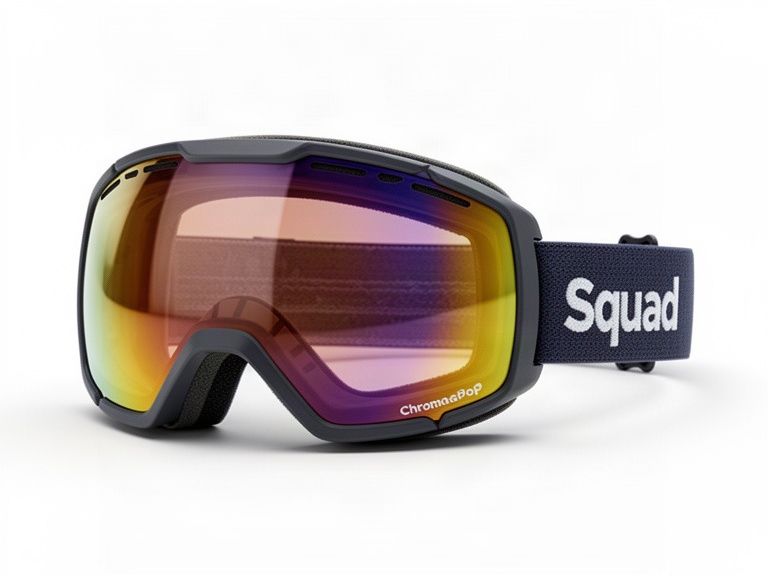
Smith Squad Goggles
Smith
A mid-priced Smith goggle with ChromaPop lens options and a second lens included.
Good for: Recreational skiers who want brand-name lenses for less
- Two lenses for sun and flat light
- ChromaPop contrast lenses at a lower price
- Comfortable medium fit for many faces
- Designed to pair with Smith helmets
- Lens swaps are slower than magnetic models
- Narrower view than premium spherical goggles
- Medium frame may be small for large faces
The Squad gives you much of what makes Smith goggles popular at a lower price. You get ChromaPop lens options for contrast and a second lens in the box, which covers both sunny days and flat light without an extra purchase.
The trade-off is convenience. Lens changes are done by hand rather than with magnets, so most people swap at the car or lodge instead of on the lift. The view is a little narrower than premium spherical goggles.
For recreational skiers who ski a handful of days a season and want a reliable, well-made goggle with two lenses, it is a sensible middle ground between budget options and premium magnetic models.
The short version: A great-value goggle with two lenses from a top brand.
AI picture- Lens changeMagnetic
- Spare lensSold separately
- Lens techUV400-rated lenses
- Lens shapeSpherical, frameless
- OTGYes, fits over many glasses
#5Best budget and over glasses8.0/10
OutdoorMaster Ski Goggles PRO
OutdoorMaster
A budget-friendly frameless goggle with a magnetic interchangeable lens and an OTG design.
Good for: Beginners, occasional skiers and glasses wearers on a budget
- Budget-friendly
- Magnetic lens change at a low price
- OTG design fits over many glasses
- Wide range of lens tints
- Lens quality and contrast are not on par with premium brands
- Spare lenses are an extra purchase
- Foam and strap are less refined
OutdoorMaster's PRO goggle is one of the most popular budget goggles, and it is easy to see why. It brings features usually found on premium models — a frameless spherical lens and a magnetic lens change — to a much lower price.
Its OTG (over-the-glasses) design leaves room for many prescription frames, which makes it a practical option for skiers who wear glasses and don't want to spend heavily. A wide range of tints is available.
You give up some optical refinement and contrast technology compared with Smith, Anon and Oakley, and the foam and strap are simpler. For beginners, kids who are still growing or occasional skiers, it covers the essentials well.
The short version: A low-cost goggle with magnetic lenses and an over-glasses fit.
Compare at a glance
| Pick | Lens change | Spare lens | Lens tech | Sizes | Score |
|---|---|---|---|---|---|
| #1 Smith I/O MAG Goggles | Magnetic MAG system with locking | Included (low-light) | ChromaPop | Small, medium and XL versions | 9.3 |
| #2 Anon M4 Goggles | Magnetic Magna-Tech system | Included | Perceive | — | 9.1 |
| #3 Oakley Flight Deck M Goggles | Manual swap | Usually sold separately | Prizm | M (medium) and L (large) | 8.9 |
| #4 Smith Squad Goggles | Manual swap | Included | ChromaPop | — | 8.6 |
| #5 OutdoorMaster Ski Goggles PRO | Magnetic | Sold separately | UV400-rated lenses | — | 8.0 |
Specs come from manufacturer listings when we wrote this guide and can change between production runs.
Buying tips
Lens tint and VLT
Lens tints are rated by VLT (visible light transmission) — the percentage of light that passes through.
- Low VLT (roughly 5–20%): dark lenses for bright, sunny days and high altitude.
- Mid VLT (about 20–40%): all-round lenses for mixed sun and cloud.
- High VLT (above 40%): light lenses for flat light, storms, snowfall and night skiing.
If you can only have one lens, choose a mid-range all-conditions tint. Better still, choose a goggle that comes with a second low-light lens, so you are covered on both bluebird and storm days.
Contrast-enhancing lenses
Brand-specific lens technologies, such as Smith ChromaPop, Oakley Prizm and Anon Perceive, filter light to boost contrast between snow textures. They don't make a dark day bright, but many skiers find they make shadows, bumps and ice easier to read. They are a common reason premium goggles cost more.
Lens shape
Cylindrical lenses curve side to side but are flat top to bottom; they are budget-friendly and give a classic look with a little more distortion at the edges. Spherical lenses curve in both directions for a wider view and less distortion. Toric lenses sit between the two. Shape matters less than lens quality and fit, but spherical and toric lenses usually feel more open.
Fit, helmets and glasses
Goggles come in small, medium and large frame sizes. The foam should seal evenly against your face with no gap at the nose or cheeks, and the top of the frame should meet your helmet's brim without a gap that exposes your forehead to wind (often called gaper gap). Try goggles with your helmet whenever possible, and check that the strap is long enough for your helmet size.
If you wear prescription glasses, look for OTG (over-the-glasses) goggles, which have deeper frames and cutouts for the arms of your glasses.
Preventing fog
All quality goggles have a double-pane lens with an anti-fog coating on the inside. To keep it working, never wipe the inside of a wet lens, which removes the coating — shake out snow and let it air-dry instead. Avoid pushing goggles onto your forehead, where body heat and sweat fog them, and keep vents clear of snow.
Care tips
Store goggles in their microfiber bag, which doubles as a cleaning cloth for the outside of the lens. Let them dry at room temperature after each day rather than on a heater, which can damage foam and glue.
FAQ
QWhat lens color is best for ski goggles?
There is no single best color. Dark, low-VLT lenses suit sunny days; light, high-VLT lenses suit flat light and snowfall. Mid-range tints are the best one-lens compromise, and goggles that include a second low-light lens give you the most flexibility.
QAre magnetic lens goggles worth it?
If conditions change often where you ski, yes. Magnetic systems let you swap lenses in seconds on the lift, which makes it much more likely you will actually carry and use the right lens.
QCan I wear ski goggles over glasses?
Yes, if you choose an OTG (over-the-glasses) model with a deeper frame and side cutouts for your glasses. Standard goggles often press on glasses and can fog more easily.
QDo ski goggles need UV protection?
Yes. Snow reflects a lot of UV light, especially at altitude. Reputable goggle lenses filter UV; check the manufacturer's description for the model you buy.
QWhy do my goggles keep fogging?
Common causes are wiping the inside of the lens, wearing goggles on your forehead, a gap between goggle and helmet, or blocked vents. Let wet lenses air-dry and make sure the goggle fits your helmet.
How we picked
We compared manufacturer information on lens systems, included lenses, lens technology, frame sizes, helmet and glasses compatibility and ventilation for popular ski and snowboard goggles from established brands, and weighed which skiers and riders each suits. Our picks and scores are based on this research — we have not tested these products hands-on. Brands cannot pay to be included. Read our full method.
In the same aisle
More ski goggles to browse
A random pull from our product catalog, not ranked or reviewed.