Best Stud Finders in 2026
Four stud finders compared, from a battery-free magnetic finder to multi-sensor and multi-scanner models, with tips for confirming studs before you drill.
- 4 picks
- 4 min read
- Updated Nov 20, 2026

As an Amazon Associate I earn from qualifying purchases. If you buy through a link here we may earn a commission, at no extra cost to you. Details
Before you hang a TV mount, a heavy mirror, floating shelves or upper cabinets, you need to find the wood or metal framing behind the wall. A stud finder speeds that up, but anyone who has used a poor one knows the frustration of beeps that move every time you scan.
There are two basic types. Electronic finders sense changes in density behind the drywall, while magnetic finders locate the screws and nails that hold drywall to the studs. Each has strengths, and the best results usually come from using a finder to narrow the search and then confirming before you drill. We compared popular models from established brands on detection method, display, scanning depth, extra modes such as metal and live-wire detection, and ease of use, and picked the best option for different walls and users.
The lineup
 Best overall Franklin Sensors ProSensor 710 Stud Finder
Most homeowners hanging shelves, mounts and art
9.1 Buy Now on Amazon
 Best with wire warning Zircon StudSensor e50 Electronic Stud Finder
Budget-minded buyers who want a deep-scan mode and a live-wire caution
8.6 Buy Now on Amazon
 Best multi-scanner Bosch GMS120 Digital Multi-Scanner
Remodelers checking for wood, metal and live wiring
8.4 Buy Now on Amazon
 Best battery-free CH Hanson Magnetic Stud Finder (03040)
A simple, reliable backup that never needs batteries
8.2 Buy Now on Amazon
AI picture
- Detection methodMulti-sensor electronic (13 sensors)
- DisplayRow of LED lights
- Batteries neededYes
- Max scan depth1-1/2 inches
#1Best overall9.1/10
Franklin Sensors ProSensor 710 Stud Finder
Franklin Sensors · Model ProSensor 710
A multi-sensor finder that lights up the full width of studs without sliding or calibrating.
Good for: Most homeowners hanging shelves, mounts and art
- Shows the full width and center of studs at a glance
- No sliding or calibration needed
- Scans deeper than many basic finders
- Simple to use for beginners
- No live-wire detection
- Can still be confused by plaster, tile and pipes
The Franklin ProSensor 710 changed how many people think about stud finders. Instead of one sensor that you slide across the wall, it uses a row of 13 sensors and a matching row of LED lights. Press it against the wall and the lights show where studs are, including both edges, so you can see the center at a glance.
Because there is no sliding or calibration, it is less prone to the shifting readings that frustrate users of single-sensor finders, and it scans up to about 1-1/2 inches deep, enough for most drywall and many thicker walls.
It does not include live-wire detection, and like every electronic finder it can be confused by plaster, tile and pipes. For typical drywall in modern homes, it is one of the easiest finders to use.
The short version: The easiest, most intuitive stud finder for typical drywall walls.
AI picture- Detection methodSingle-sensor electronic (edge finding)
- DisplayLCD screen
- Batteries neededYes (9V)
- Scan modesStudScan and DeepScan
#2Best with wire warning8.6/10
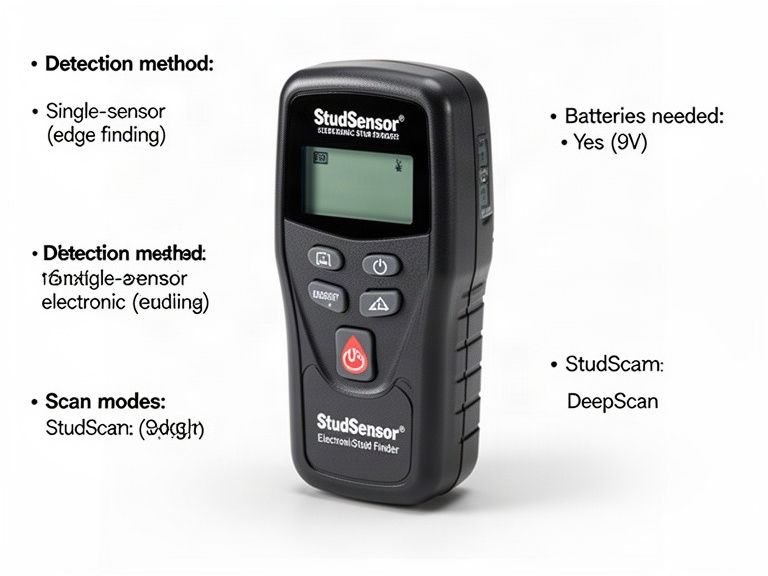
Zircon StudSensor e50 Electronic Stud Finder
Zircon · Model e50
A long-running edge-finding stud sensor with a deep-scan mode and live AC wire warning.
Good for: Budget-minded buyers who want a deep-scan mode and a live-wire caution
- DeepScan mode for thicker walls
- WireWarning detection of live AC as an extra caution
- Clear LCD screen
- Budget-friendly and widely available
- Must calibrate on a spot with no stud
- Shows edges, so you mark both sides to find the center
- Sensitive to technique
Zircon has made stud finders for decades, and the StudSensor e50 is one of its longest-running models. It is a classic edge-finding sensor: place it on the wall, let it calibrate, then slide it until the screen shows a stud edge. Mark both edges and the center is between them.
A DeepScan mode helps with thicker walls, and WireWarning detection alerts you to some live AC wiring as an extra caution before you drill.
The edge-finding method takes more technique than a multi-sensor finder, and starting calibration over a stud gives false readings. Once you learn its rhythm, it is a dependable, budget-friendly tool.
The short version: A dependable, budget-friendly sensor with deep scanning and a live-wire warning.
AI picture- Detection methodMulti-mode scanner (wood, metal, live AC)
- DisplayLCD screen
- Batteries neededYes
#3Best multi-scanner8.4/10
Bosch GMS120 Digital Multi-Scanner
Bosch · Model GMS120
A multi-mode scanner that detects wood studs, metal and live AC wiring.
Good for: Remodelers checking for wood, metal and live wiring
- Separate modes for wood, metal and live wiring
- Metal mode helps locate pipes, rebar and lath nails
- Clear LCD display
- Useful before drilling into unknown walls
- More complex than single-purpose finders
- Wood mode still needs careful technique
The Bosch GMS120 is more than a stud finder. It has separate modes for wood, metal and live AC wiring, which makes it useful before drilling into walls whose contents you do not know, such as in older homes or during remodels.
On plaster and lath walls, its metal mode can help you find the rows of nails that hold the lath to studs, an approach that often works better than density-based wood scanning.
The extra modes make it more complex than a single-purpose finder, and wood detection still benefits from a careful, slow scan. For remodelers and anyone who wants to check for metal and wiring before drilling, it is a versatile tool.
The short version: A versatile multi-scanner for older walls and remodeling projects.
AI picture- Detection methodMagnetic (locates screws and nails)
- DisplayNone, magnets stick at fasteners
- Batteries neededNo
#4Best battery-free8.2/10
CH Hanson Magnetic Stud Finder (03040)
CH Hanson · Model 03040
A small magnetic finder that locates the screws and nails holding drywall to studs.
Good for: A simple, reliable backup that never needs batteries
- No batteries or calibration
- Not fooled by density changes
- Works on plaster and lath by finding nails
- Small and budget-friendly
- Finding fasteners takes patience
- Does not show stud width
- Can stick to metal pipes or corner bead
The CH Hanson magnetic stud finder takes a different approach. Strong magnets inside the small body are drawn to the screws and nails that fasten drywall to studs, and the finder sticks to the wall when it passes over one. Find a vertical line of fasteners and you have found the stud.
Because it does not read density, it is not fooled by many of the things that confuse electronic finders, and it needs no batteries or calibration. That makes it a good choice for plaster walls and a reliable backup for any toolbox.
It takes patience to sweep the wall for fasteners, it does not show stud width, and it will also stick to metal pipes or corner bead. Confirm with a second fastener above or below before you drill.
The short version: A simple, battery-free finder that works where electronic models struggle.
Compare at a glance
| Pick | Detection method | Display | Batteries needed | Max scan depth | Score |
|---|---|---|---|---|---|
| #1 Franklin Sensors ProSensor 710 Stud Finder | Multi-sensor electronic (13 sensors) | Row of LED lights | Yes | 1-1/2 inches | 9.1 |
| #2 Zircon StudSensor e50 Electronic Stud Finder | Single-sensor electronic (edge finding) | LCD screen | Yes (9V) | — | 8.6 |
| #3 Bosch GMS120 Digital Multi-Scanner | Multi-mode scanner (wood, metal, live AC) | LCD screen | Yes | — | 8.4 |
| #4 CH Hanson Magnetic Stud Finder (03040) | Magnetic (locates screws and nails) | None, magnets stick at fasteners | No | — | 8.2 |
Specs come from manufacturer listings when we wrote this guide and can change between production runs.
Buying tips
Electronic or magnetic?
Electronic stud finders measure changes in the wall's density. Single-sensor models find a stud's edges as you slide them across the wall; multi-sensor models use a row of sensors to show the whole width of a stud at once, without sliding or calibrating on a blank spot. Magnetic stud finders contain strong magnets that grab drywall screws and nails. They need no batteries and are not fooled by density changes, but you have to search for fasteners, which can take a little longer.
Features worth paying for
- Full-width display that shows where the stud starts and ends, so you can aim for the center.
- Deep-scan mode for thicker walls, double drywall or paneling.
- Live AC wire warning as an extra caution, though no finder detects every wire.
- Metal detection to locate pipes, metal studs and rebar before drilling.
Walls that confuse stud finders
Plaster and lath walls, textured or very thick walls, tile, wallpaper with metallic backing, and walls with pipes or ductwork behind them can all produce false readings. On plaster, a magnetic finder that locates lath nails often works better than an electronic one. Wet drywall and areas near outlets can also throw off electronic sensors.
Confirm before you drill
Use more than one clue. Studs are usually spaced 16 inches on center, sometimes 24, so measure from a found stud to predict the next one. Outlets and switches are usually mounted to the side of a stud. Before drilling a large hole, push a thin finishing nail through the drywall in a spot that will be hidden to confirm you hit wood, and drill a small pilot hole first.
Safety around wiring and pipes
Live-wire indicators are a helpful warning, not a guarantee. Wires and pipes often run vertically above and below outlets and switches and horizontally between them, so avoid drilling in those zones. When in doubt, switch off the circuit at the breaker before drilling, use a non-contact voltage tester, and hire a licensed electrician or plumber for work involving wiring or pipes. Follow the manufacturer's instructions for your stud finder and the mounting hardware.
FAQ
QWhy does my stud finder give different readings every time?
Electronic finders are sensitive to how they are calibrated, how flat they are held and what is behind the wall. Calibrate on a spot without a stud, keep the tool flat and move slowly. Multi-sensor and magnetic finders tend to be more consistent.
QDo stud finders work on plaster walls?
Electronic finders often struggle with plaster and lath because the density varies so much. A strong magnetic finder that locates the nails holding the lath is often more reliable on older walls.
QCan a stud finder detect electrical wires?
Some models warn of live AC wiring, but detection is not guaranteed, especially for wires deep in the wall, shielded cable or circuits that are switched off. Treat it as an extra caution, not a safety check.
QHow far apart are wall studs?
Most modern homes use 16 inches on center, measured from the center of one stud to the next. Some walls, garages and older homes use 24-inch spacing or irregular spacing near doors and windows.
QCan I hang a TV without finding a stud?
Some lighter TVs and mounts can use heavy-duty drywall anchors rated for the load, but for most TV mounts, the manufacturer requires attaching to studs. Follow the mount's instructions and weight ratings.
How we picked
We compared manufacturer specifications for detection method, sensor design, display, scanning depth, extra detection modes and power requirements, along with warranty terms, for stud finders from established brands that are widely available online. Our picks and scores are based on this research — we have not tested these products hands-on. Brands cannot pay to be included. Read our full method.
In the same aisle
More stud finders to browse
A random pull from our product catalog, not ranked or reviewed.