Best USB Audio Interfaces in 2026
Five well-regarded two-channel USB audio interfaces compared, from budget-friendly starter boxes to desktop units with standout preamps and metering.
- 5 picks
- 6 min read
- Updated Nov 20, 2026

As an Amazon Associate I earn from qualifying purchases. If you buy through a link here we may earn a commission, at no extra cost to you. Details
An audio interface is the box that sits between your microphones, instruments and speakers and your computer. It converts the signal from a mic or guitar into digital audio your recording software can use, supplies phantom power for condenser mics, and gives you clean headphone and monitor outputs with almost no delay. For most home recording, a two-input USB interface is the sweet spot: enough for a vocal and a guitar at the same time, or two podcast hosts, without paying for inputs you will never use.
The trouble is that the popular models look almost identical on paper. Nearly all of them promise 24-bit audio, two mic preamps and USB bus power. The differences that matter day to day are preamp noise and gain, how easy the meters are to read, headphone volume, build quality and the software in the box. We compared the most popular, long-running two-channel interfaces sold in the US and picked the best one for different kinds of home studios.
The lineup
 Best overall Focusrite Scarlett 2i2 (4th Gen)
Most home studios recording one or two sources
9.3 Buy Now on Amazon
 Best metering MOTU M2
Producers who want precise levels and clean monitor outputs
9.0 Buy Now on Amazon
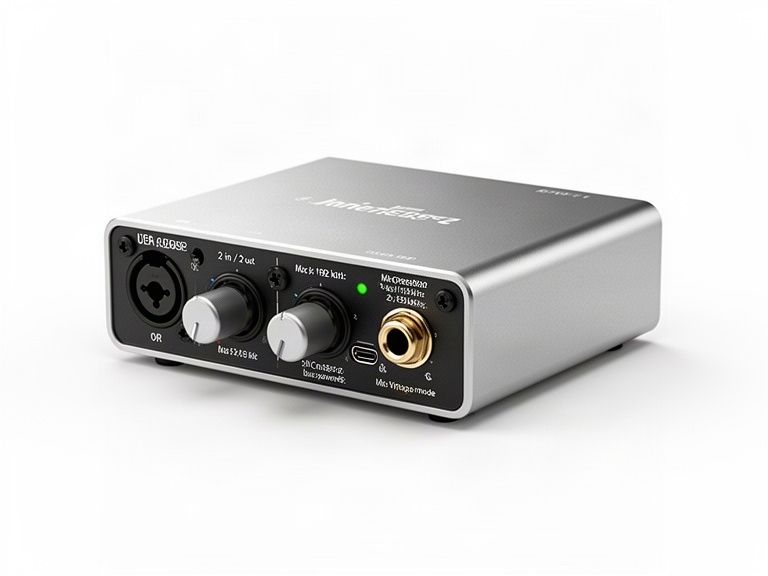 Best for vintage character Universal Audio Volt 2
Singers and guitarists who want a warmer tone at the source
8.8 Buy Now on Amazon
 Best for one mic plus guitar Audient iD4 MkII
Solo musicians recording one mic and one instrument
8.6 Buy Now on Amazon
 Best budget PreSonus AudioBox USB 96
Beginners who want a simple, affordable first interface
8.2 Buy Now on Amazon
AI picture
- Inputs / outputs2 in / 2 out
- Max resolution24-bit / 192 kHz
- ConnectionUSB-C, bus-powered
- Mic preamps2, up to 69 dB of gain
- Level helpersAuto Gain and Clip Safe
#1Best overall9.3/10
Focusrite Scarlett 2i2 (4th Gen)
Focusrite
The best-known two-channel interface, updated with more preamp gain plus Auto Gain and Clip Safe features that help beginners set levels.
Good for: Most home studios recording one or two sources
- Generous preamp gain suits quiet dynamic mics
- Auto Gain and Clip Safe make setting levels easier
- Air mode adds optional presence and brightness
- Huge user base, so tutorials and support are easy to find
- Metering is still basic halo rings rather than a screen
- No MIDI ports
- Loopback and some features need the companion software
The Scarlett 2i2 has been the default suggestion for a first interface for years, and the 4th Gen version addresses the old weak spot: gain. Focusrite rates its preamps at up to 69 dB, which gives quiet broadcast-style dynamic mics more room than earlier versions had.
Two features stand out for newcomers. Auto Gain listens to you sing or play for a few seconds and sets the level for you, and Clip Safe is designed to pull the gain down automatically if a loud moment would otherwise distort. Air mode, a Focusrite signature, adds an optional lift to the upper frequencies that some singers like on vocals.
The trade-offs are small. Level metering is still a ring of light around each gain knob, which is less precise than a proper meter, and there are no MIDI ports. For most people recording vocals, guitar or a two-person podcast, it covers everything that matters.
The short version: The most dependable all-round choice for a home studio, with more gain and smarter level-setting than earlier generations.
AI picture- Inputs / outputs2 in / 2 out
- Max resolution24-bit / 192 kHz
- ConnectionUSB-C, bus-powered
- Mic preamps2
- MeteringFull-color LCD meters
#2Best metering9.0/10
MOTU M2
MOTU · Model M2
A two-channel interface with a full-color level meter screen and high-end ESS Sabre converters on its outputs.
Good for: Producers who want precise levels and clean monitor outputs
- Color LCD meters show input and output levels at a glance
- ESS Sabre32 Ultra DAC on the outputs
- Built-in loopback for streaming and podcasting
- Both balanced and RCA monitor outputs
- Fewer beginner helpers than the Scarlett
- Metal case is a little larger than some rivals
The MOTU M2 is the interface people tend to recommend when someone asks for a step up in clarity without leaving the two-channel class. Its most visible feature is a small full-color LCD that shows input and output levels at the same time, which is far easier to read than the single-color rings on most competitors.
Behind the panel, MOTU uses an ESS Sabre32 Ultra DAC for the outputs, the kind of converter often found in dedicated hi-fi gear. That matters most when you are listening critically on good monitors or headphones. Loopback is built in, and the rear panel offers both balanced 1/4-inch outputs and RCA jacks, which makes connecting budget speakers simple.
What it lacks is hand-holding. There is no auto-gain feature, so you set levels yourself, which the meters make straightforward.
The short version: The pick for anyone who values clear metering and high-quality monitoring over beginner shortcuts.
AI picture- Inputs / outputs2 in / 2 out
- Max resolution24-bit / 192 kHz
- ConnectionUSB-C, bus-powered
- Mic preamps2, with Vintage mode
#3Best for vintage character8.8/10
Universal Audio Volt 2
Universal Audio · Model Volt 2
A two-channel interface with a Vintage preamp mode modeled on UA’s classic tube preamp sound.
Good for: Singers and guitarists who want a warmer tone at the source
- Vintage mode adds warmth and color while you record
- Solid, retro-styled build
- Comes from one of the most respected names in studio gear
- Simple front-panel layout
- Basic LED metering
- Vintage mode is a color, not a substitute for good mic technique
- Feature set is lean compared with similarly priced rivals
Universal Audio is best known for high-end studio hardware and plugins, and the Volt 2 brings a bit of that heritage to a home-studio price. Its headline feature is Vintage mode, a switch on each preamp that UA designed to emulate the character of its classic tube mic preamp. On paper it adds a little warmth and harmonic richness on the way in, which owners often point out suits vocals and acoustic guitar.
Beyond that, it is a straightforward two-in, two-out USB-C interface with phantom power, direct monitoring and a headphone output. The retro styling and sturdy build are part of the appeal.
The catch is that you pay partly for the name and the Vintage switch. Metering is basic, and if you prefer a clean signal you can color later with plugins, a more feature-rich interface may be the better use of your budget.
The short version: A stylish, well-built choice if you want a touch of analog-style warmth baked into your recordings.
AI picture- Inputs / outputs2 in / 2 out
- Max resolution24-bit / 96 kHz
- ConnectionUSB-C (USB 3.0), bus-powered
- Mic preamps1, plus JFET instrument input
- Headphone outputs2 (1/4-inch and 3.5 mm)
#4Best for one mic plus guitar8.6/10
Audient iD4 MkII
Audient · Model iD4 MkII
A compact interface with one console-grade mic preamp, a separate instrument input and two headphone jacks.
Good for: Solo musicians recording one mic and one instrument
- Preamp design borrowed from Audient’s mixing consoles
- Dedicated JFET instrument input for guitar or bass
- Two headphone outputs for sharing a session
- ScrollControl turns the big knob into a mouse-wheel controller
- Only one microphone input
- Tops out at 96 kHz
The Audient iD4 MkII is built around a simple idea: most solo musicians only need one really good mic preamp. It uses the same preamp design Audient puts in its larger recording consoles, plus a separate JFET instrument input on the front for guitar or bass, so you can sing and play at the same time.
Small touches make it pleasant to use. There are two headphone outputs, a full-size jack and a 3.5 mm jack, so a collaborator can listen in. The large metal volume knob doubles as ScrollControl, letting you adjust plugin parameters in your recording software as if it were a mouse wheel.
The obvious limit is that it records only one microphone at a time, so it does not suit two-person podcasts or stereo mic setups. If your world is one voice and one instrument, it is a compact, well-made fit.
The short version: A smart, compact pick for singer-songwriters who never need more than one mic at a time.
AI picture- Inputs / outputs2 in / 2 out
- Max resolution24-bit / 96 kHz
- ConnectionUSB 2.0 (Type-B), bus-powered
- Mic preamps2
- MIDI5-pin in and out
#5Best budget8.2/10
PreSonus AudioBox USB 96
PreSonus · Model AudioBox USB 96
A long-running, no-frills two-channel interface with MIDI ports and a knob for every job.
Good for: Beginners who want a simple, affordable first interface
- Very simple layout with one knob per function
- Built-in 5-pin MIDI in and out
- Two combo inputs for mic, line or instrument
- Long track record, so it is easy to find help online
- Uses an older USB Type-B port
- Less clean gain for quiet dynamic mics than newer designs
- Basic clip-light metering
The AudioBox USB 96 has been around for years, and its appeal is that there is nothing to figure out. Two combo inputs accept a microphone, a line-level source or an instrument, each with its own gain knob, and there are separate knobs for headphone volume, main output level and the balance between your live input and computer playback.
It is also one of the few budget interfaces with 5-pin MIDI in and out, which is useful if you own an older keyboard or drum machine without a USB port.
The compromises reflect its age and price. It connects with a USB Type-B cable rather than USB-C, its preamps have less clean gain than newer designs, which matters with quiet broadcast-style dynamic mics, and metering is limited to simple clip lights. For a first interface used with condenser mics or a guitar, it does the job.
The short version: An affordable, dependable starter interface, especially if you need old-school MIDI ports.
Compare at a glance
| Pick | Inputs / outputs | Max resolution | Connection | Mic preamps | Score |
|---|---|---|---|---|---|
| #1 Focusrite Scarlett 2i2 (4th Gen) | 2 in / 2 out | 24-bit / 192 kHz | USB-C, bus-powered | 2, up to 69 dB of gain | 9.3 |
| #2 MOTU M2 | 2 in / 2 out | 24-bit / 192 kHz | USB-C, bus-powered | 2 | 9.0 |
| #3 Universal Audio Volt 2 | 2 in / 2 out | 24-bit / 192 kHz | USB-C, bus-powered | 2, with Vintage mode | 8.8 |
| #4 Audient iD4 MkII | 2 in / 2 out | 24-bit / 96 kHz | USB-C (USB 3.0), bus-powered | 1, plus JFET instrument input | 8.6 |
| #5 PreSonus AudioBox USB 96 | 2 in / 2 out | 24-bit / 96 kHz | USB 2.0 (Type-B), bus-powered | 2 | 8.2 |
Specs come from manufacturer listings when we wrote this guide and can change between production runs.
Buying tips
How many inputs do you need?
Count the sources you need to record at the same time, not the total number of instruments you own.
- One input covers a singer-songwriter who records vocals and guitar on separate takes.
- Two inputs cover singing and playing at once, a stereo pair of mics, or two podcast hosts. This is the size most home studios settle on.
- Four or more inputs are for recording a drum kit or a full band live. If that is your plan, skip this category and look at larger desktop or rack interfaces.
Make sure at least one input is a combo jack with an instrument (Hi-Z) setting if you want to plug a guitar or bass in directly.
What the specs actually mean
Sample rate and bit depth. Every pick here records at 24-bit, which gives plenty of headroom. Rates of 44.1 or 48 kHz are what most music and video projects use, so the difference between a 96 kHz and a 192 kHz ceiling rarely matters at home.
Preamp gain. Quiet dynamic microphones, such as broadcast-style podcast mics, need a lot of clean gain. An interface with more usable gain lets you reach a healthy level without turning every knob to the maximum, where hiss creeps in.
Direct monitoring. A direct-monitor switch or blend knob lets you hear yourself through headphones before the signal goes through the computer, so there is no distracting delay while you sing or play.
Features worth paying for
- Clear level meters. Multi-segment or screen-based meters make it much easier to set levels than a single color-changing ring.
- Loud, clean headphone output. Especially useful if you own high-impedance studio headphones.
- Loopback. Lets you capture computer audio, such as a video call or backing track, along with your mic. Handy for streaming and podcasting.
- Auto-gain or clip protection. Helpful for beginners who are still learning how loud to set inputs.
What you can skip
Do not pay extra for the highest sample rate on the box, and do not choose an interface for its bundled plugins alone. Bundles change often, and free recording software is easy to find. A sturdy build, good preamps and drivers that are kept up to date matter more over the years.
Setup and care tips
Install the manufacturer's driver or control software before plugging in, especially on Windows. Use the cable that came in the box or a good-quality replacement, since many dropouts trace back to a worn USB cable or an unpowered hub. Turn your monitor speakers off before switching phantom power on or off to avoid loud pops, and keep the interface away from drinks on a crowded desk.
FAQ
QDo I need an audio interface if I already have a USB microphone?
Not for that microphone, since a USB mic has its own converter built in. You need an interface when you want to use XLR microphones, record an electric guitar directly, connect studio monitors, or record two sources at once.
QIs 192 kHz better than 96 kHz for home recording?
For most people, no. Music and video projects usually run at 44.1 or 48 kHz, and higher rates mainly create bigger files and more work for your computer. Preamp quality and good gain staging make a bigger difference.
QCan I plug an electric guitar straight into an audio interface?
Yes, as long as you use an input with an instrument or Hi-Z setting. That setting matches the guitar’s output so it does not sound thin. You can then use amp-simulation plugins in your recording software.
QWhat is phantom power, and do I need it?
Phantom power is a 48-volt supply sent through the XLR cable to power condenser microphones. Dynamic mics do not need it. Every interface in this guide provides it, usually with a single switch.
QWill these interfaces work with an iPad?
Many class-compliant interfaces do, but some need more power than a tablet supplies, so you may need a powered USB hub or the right adapter. Check the manufacturer’s compatibility notes for your exact device before buying.
How we picked
We compared manufacturer specifications for input and output counts, preamp gain, converters, metering, headphone outputs, connection type and bundled software for the most popular two-channel USB audio interfaces consistently available in the US, and weighed how each one suits different home-studio setups. Our picks and scores are based on this research — we have not tested these products hands-on. Brands cannot pay to be included. Read our full method.
In the same aisle
More usb audio interfaces to browse
A random pull from our product catalog, not ranked or reviewed.