Best Walking Canes in 2026
Four walking canes compared — self-standing, offset, folding and quad designs — with tips on handles, tips and getting the height right.
- 4 picks
- 4 min read
- Updated Nov 20, 2026
As an Amazon Associate I earn from qualifying purchases. If you buy through a link here we may earn a commission, at no extra cost to you. Details
A cane is the simplest mobility aid, but the right one makes a noticeable difference to how steady and confident you feel on your feet. A cane at the wrong height, with a slippery tip or an uncomfortable handle, tends to end up leaning in a corner instead of helping.
Canes now come in several designs: classic single-point canes with offset handles, folding canes that fit in a bag, self-standing canes with pivoting bases and quad canes with four feet for a broader footprint. We compared four widely available canes from HurryCane, Drive Medical, Vive and Medline on base design, handle, adjustability and portability. A cane is a medical aid, so ask your doctor or a physical therapist which type suits your balance and strength, have them help set the height and show you how to walk with it, and follow the manufacturer’s instructions and weight limits.
The lineup
 Best self-standing HurryCane Freedom Edition Folding Cane
People tired of picking up a dropped cane
9.0 Buy Now on Amazon
 Best value Drive Medical Adjustable Offset Handle Cane
A simple, sturdy everyday cane
8.6 Buy Now on Amazon
 Best for extra stability Medline Quad Cane, Small Base
People advised to use a broader base
8.3 Buy Now on Amazon
AI picture
- Cane typeFolding, self-standing
- BasePivoting three-point tip
- Height adjustmentPush-button
#1Best self-standing9.0/10
HurryCane Freedom Edition Folding Cane
HurryCane
A folding cane with a pivoting three-point base that lets it stand on its own.
Good for: People tired of picking up a dropped cane
- Stands on its own when you let go
- Pivoting base stays in contact as the cane angles
- Folds for travel and storage
- Ergonomic handle
- Base is bulkier than a single rubber tip
- Takes a short adjustment period
- Some users prefer the feel of a standard tip
Every cane user knows the routine: lean it against a counter, watch it slide to the floor, then bend down to retrieve it. HurryCane’s Freedom Edition is designed to end that, with a pivoting three-point base that lets the cane stand upright on its own.
The base also flexes as the cane angles with each step, keeping more of the tip in contact with the ground. When you don’t need it, the shaft folds down for a car, bag or closet.
The base is wider than a standard rubber tip, and some people find it takes a little getting used to. Ask your physical therapist whether it suits your walking pattern.
The short version: The most convenient everyday cane if constantly picking it up is a frustration.
AI picture- Cane typeOffset single-point
- BaseRubber tip
- Height adjustmentPush-button
- ShaftAluminum
#2Best value8.6/10
Drive Medical Adjustable Offset Handle Cane
Drive Medical
A classic aluminum offset cane with a cushioned grip and push-button height adjustment.
Good for: A simple, sturdy everyday cane
- Offset handle places your hand over the tip
- Lightweight aluminum shaft
- Simple push-button height adjustment
- Budget-friendly and easy to replace tips
- Doesn’t stand on its own
- Doesn’t fold for travel
The classic offset cane is still the default for good reason. Drive Medical’s version has a bend in the shaft that puts your hand directly over the tip, a cushioned grip and a push-button pin that adjusts the height in moments.
The aluminum shaft keeps it light, and replacement rubber tips are easy to find.
It doesn’t fold or stand on its own, so it’s less convenient to stow than the HurryCane or a folding cane. For a straightforward, affordable everyday cane, though, it’s a dependable choice — have your physical therapist set the height.
The short version: A no-nonsense, affordable offset cane that covers the essentials well.
 AI picture
- Cane typeFolding single-point
- BaseRubber tip
- Height adjustmentPush-button
#3Best folding8.4/10
Vive Folding Cane
Vive
A lightweight cane that folds into sections to fit in a bag when you don’t need it.
Good for: Occasional users and travelers
- Folds small enough for a bag or glove box
- Lightweight for all-day carrying
- Adjustable height
- Wrist strap keeps it close
- Folding joints need occasional checking
- Doesn’t stand on its own
- Less rigid feel than a one-piece cane
Some people need a cane only some of the time — on long walks, in crowds or on uneven ground. Vive’s folding cane suits that pattern: it breaks down into sections that fit in a tote or glove box, then snaps back together when you need it.
It’s light enough to carry all day, adjusts for height and has a wrist strap so it stays with you when you open a door.
Folding canes have more joints than one-piece canes, so check that each section locks fully before putting weight on it, and follow Vive’s weight limit.
The short version: A practical, portable cane for people who don’t need one every minute of the day.
AI picture- Cane typeQuad (four-point)
- BaseSmall four-tip base
- Height adjustmentPush-button
#4Best for extra stability8.3/10
Medline Quad Cane, Small Base
Medline
A four-point cane with a small rectangular base that stands on its own.
Good for: People advised to use a broader base
- Four feet give a broader footprint
- Stands on its own
- Small base is easier to maneuver than a large one
- From a major medical supplier
- Heavier than a single-point cane
- Slower to walk with
- Base can catch on stairs and curbs
Physical therapists often recommend a quad cane when someone needs a broader base than a single tip provides. Medline’s small-base quad cane has four rubber-tipped feet on a compact rectangular base, so it stands on its own and spreads contact over a wider area.
The small base is easier to maneuver around a home than a large one, and the height adjusts with a push-button pin.
Quad canes are heavier and slower than single-point canes, and the base needs care on stairs. Use one if your therapist recommends it, and have them show you the right technique.
The short version: The choice when your therapist recommends a broader, four-point base.
Compare at a glance
| Pick | Cane type | Base | Height adjustment | Shaft | Score |
|---|---|---|---|---|---|
| #1 HurryCane Freedom Edition Folding Cane | Folding, self-standing | Pivoting three-point tip | Push-button | — | 9.0 |
| #2 Drive Medical Adjustable Offset Handle Cane | Offset single-point | Rubber tip | Push-button | Aluminum | 8.6 |
| #3 Vive Folding Cane | Folding single-point | Rubber tip | Push-button | — | 8.4 |
| #4 Medline Quad Cane, Small Base | Quad (four-point) | Small four-tip base | Push-button | — | 8.3 |
Specs come from manufacturer listings when we wrote this guide and can change between production runs.
Buying tips
Which type of cane?
- Single-point canes are light and simple. An offset handle — where the shaft bends so your hand sits over the tip — puts your weight more directly over the cane than a classic crook handle.
- Folding canes break down into sections held by an internal cord, so they fit in a bag or under a seat when you don’t need them.
- Self-standing canes have a wider, flexible base that lets the cane stand on its own, so you aren’t constantly bending to pick it up.
- Quad canes have four small feet on a rectangular base. They stand on their own and give a broader footprint, but they are heavier and slower to use. A physical therapist can tell you whether you need a small or large base.
Getting the height right
A common starting point is a handle that lines up with the crease of your wrist when you stand upright in your usual shoes with your arms relaxed, so your elbow bends slightly when you hold it. Most canes adjust with a push-button pin — check that it clicks fully into place every time. Your physical therapist can fine-tune the height and teach you which hand to use, which is usually the side opposite a weaker leg.
Handles and grips
Handles matter more than people expect. Cushioned foam or gel grips are kinder to hands that hold a cane all day, and ergonomic palm grips spread pressure across the hand (they’re made for either the right or left hand). Crook handles can hang over your arm or a chair back but tend to be less comfortable for heavy use.
Tips and maintenance
The rubber tip is your cane’s tire. Replace it when the tread wears smooth or cracks, and look for winter ice-tip attachments if you live somewhere icy. Check the push-button pins and folding joints regularly for wear.
What to skip
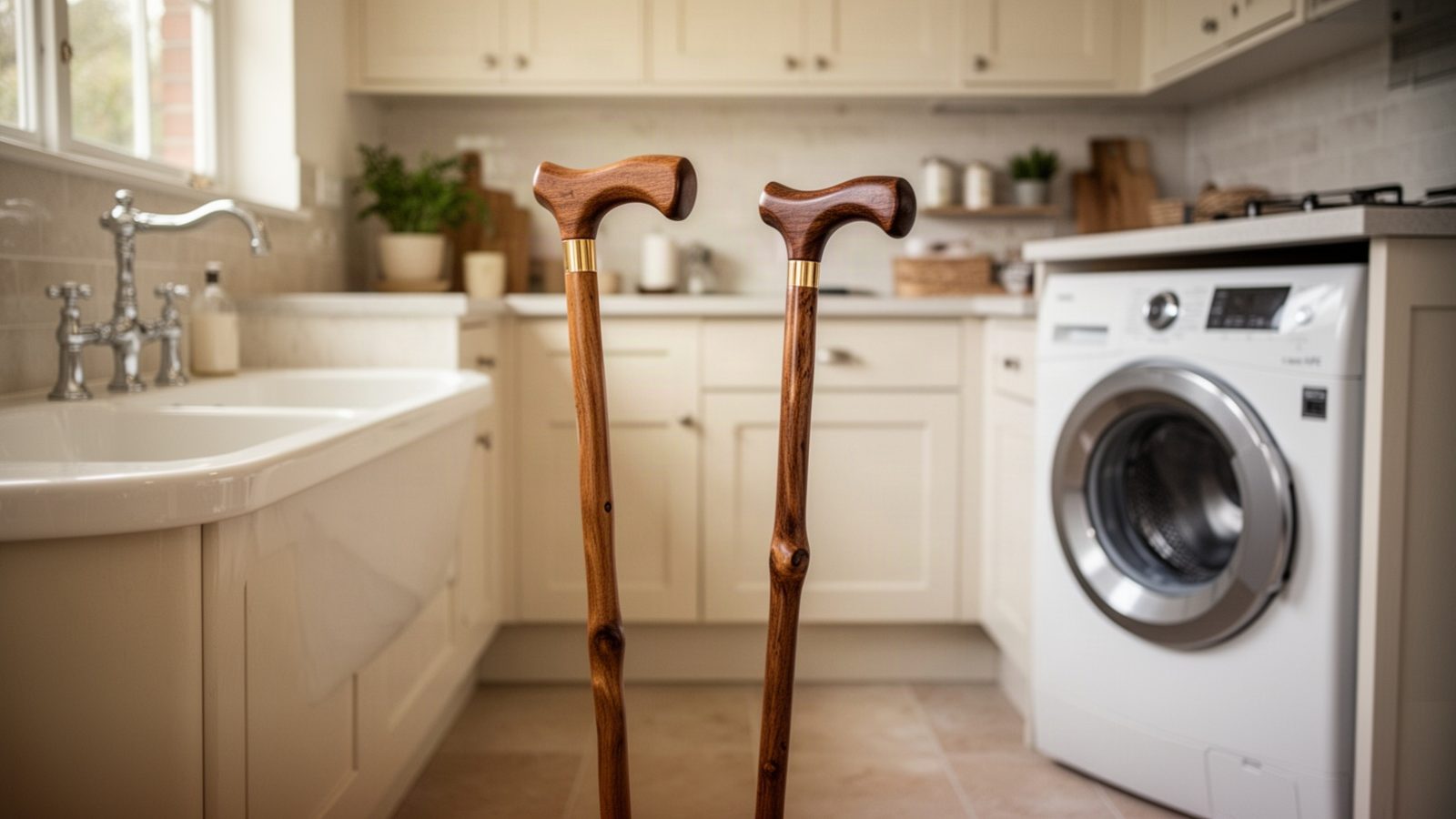
Decorative wooden canes cut to a fixed length rarely fit well unless professionally sized, and they can’t be adjusted later. And if you find yourself leaning heavily on a cane or feeling unsteady with it, talk to your doctor or therapist — a walker or rollator may be a better fit.
FAQ
QHow do I know what height my cane should be?
A common guideline is a handle level with your wrist crease when you stand upright with arms relaxed, giving a slight bend in the elbow. A physical therapist can check the fit and adjust it for your posture and footwear.
QWhich hand should I hold my cane in?
Physical therapists usually recommend holding it on the side opposite a weaker or injured leg, but the right technique depends on your situation. Ask your doctor or therapist to show you.
QIs a quad cane better than a regular cane?
A quad cane has a broader base and stands on its own, but it’s heavier and slower to use. Whether you need one depends on your balance and strength, so ask a physical therapist.
QWhen should I replace my cane tip?
Replace it when the tread looks smooth or worn, the rubber cracks or the tip no longer grips well on smooth floors. Buy the tip size that matches your cane’s shaft.
QAre folding canes as sturdy as fixed canes?
Well-made folding canes are designed for everyday use, but they have more joints to check. Make sure each section locks fully and follow the manufacturer’s weight limit.
How we picked
We compared cane types, base and tip design, handle shapes, adjustability, folding mechanisms, portability and manufacturer guidance for widely available walking canes, and weighed which users each design suits. Our picks and scores are based on this research — we have not tested these products hands-on. Brands cannot pay to be included. Read our full method.
In the same aisle
More walking canes to browse
A random pull from our product catalog, not ranked or reviewed.